Real estate website lead generation requires balancing high-end aesthetics with seamless backend utility.
Award winning layouts often fail because they prioritize visual noise over clear conversion paths.
Modern buyers demand immediate access to property data and friction free communication channels.
When an interface makes it difficult to filter listings, high intent traffic abandons the domain.
Your platform must function as a high performing digital sales funnel, something more than just a static branding piece.
At TREMGroup, we engineer digital solutions that translate premium branding into measurable revenue.
We build the infrastructure that optimizes your digital marketing spend for predictable database growth.
Does your current platform prioritize visual design or functional conversion? Let us know below.
Increase your sales: https://ift.tt/aZIjVfh
Lead Generation for Real Estate: https://ift.tt/ebgwFBP
New Construction Marketing: https://ift.tt/KA0Qv2x
Websites for Real Estate Agents, Teams & Brokers: https://ift.tt/sqIvbcO
Case Studies: https://ift.tt/WUOKnRD
Client Testimonials: https://ift.tt/pmISW8A
Info email: info@tremgroup.com
Website: www.tremgroup.com
Our socials:
Facebook: https://ift.tt/BjIkUWx
Instagram: https://ift.tt/kZe9q2h
LinkedIn: https://ift.tt/6eQvEiV
X: https://twitter.com/tremgroup
Linktree: https://linktr.ee/tremgroup
via
Wednesday, September 9, 2026

How to turn old real estate leads into new project sales
Most real estate agents treat cold leads as dead leads, leaving massive potential revenue sitting untouched in their database.
When a new project or pre-construction development hits the market, your historic pipeline should be your highest-converting asset.
Adrian Sanchez and the team at Worth Group understand that long-term real estate marketing isn't just about top-of-funnel lead generation—it’s about continuous database reactivation.
By pairing high-performance real estate websites with client profile display ads and automated backend tracking, Adrian’s team seamlessly turns past prospects into active buyers the moment a new project drops.
When your tech stack maintains those relationships automatically, every new inventory announcement becomes an instant launchpad for sales.
Stop starting from scratch with every launch. Delegate your tech to a strategic partner and turn your website into a long-term asset.
Explore their platform here: https://ift.tt/m1VGyXv
Increase your sales: https://ift.tt/aZIjVfh
Lead Generation for Real Estate: https://ift.tt/ebgwFBP
New Construction Marketing: https://ift.tt/KA0Qv2x
Websites for Real Estate Agents, Teams & Brokers: https://ift.tt/sqIvbcO
Case Studies: https://ift.tt/WUOKnRD
Client Testimonials: https://ift.tt/pmISW8A
Info email: info@tremgroup.com
Website: www.tremgroup.com
Our socials:
Facebook: https://ift.tt/BjIkUWx
Instagram: https://ift.tt/kZe9q2h
LinkedIn: https://ift.tt/6eQvEiV
X: https://twitter.com/tremgroup
Linktree: https://linktr.ee/tremgroup
via
via
Tuesday, September 8, 2026
How a TINY $10K mistake can hide your house from every buyer online [67]
Real estate MLS search parameters dictate why pricing a house at $510k instead of $500k destroys online visibility.
Buyers and agents set rigid search brackets (like $450k to $500k), meaning that extra $10k makes your listing disappear.
By pushing past round numbers, you force your inventory to compete against higher-end $550k properties.
A serious pricing strategy requires a deep understanding of modern consumer search habits.
When real estate websites integrate custom IDX search features, top agents ensure listings reach active buyers without friction.
Read our full guide on managing agent workflows and pricing strategies on the TREMGroup blog: https://ift.tt/2PkiDjE
via
via
Monday, September 7, 2026
Real Estate Agent vs Realtor: What’s the Difference?
Ask ten people on the street and nine will tell you a Realtor is just a fancier word for a real estate agent. The two get used interchangeably in listings, in news coverage, and in everyday conversation. They are not the same thing, and the difference is simpler than most explanations make it.
Every Realtor is a real estate agent, a broker, or another licensed professional in the business. Not every agent is a Realtor.
The gap between the two comes down to one thing: membership in the National Association of Realtors, the trade organization that owns the Realtor trademark and holds its members to a written Code of Ethics.
We covered the licensing side, state requirements, and salary picture in our complete guide to the realtor vs real estate agent question.
This piece goes deeper on the part that actually separates the titles: what NAR membership involves, what the Code of Ethics adds in practice, what it costs, and whether any of it should change who you hire or how you build your career.
The Short Answer
A real estate agent is anyone who holds a state-issued license to help clients buy, sell, or rent property. The state grants that license after coursework, an exam, and a background check, and the state can take it away.
A Realtor is a licensed agent or broker who has also joined the National Association of Realtors through a local Realtor association. Membership brings a trademarked title, a Code of Ethics with real enforcement teeth, and access to the association’s tools, data, and referral network.
So the title tells you about affiliation, not about skill. A 20-year veteran who closes 50 deals a year can be a plain licensed agent. A brand-new licensee three weeks out of the exam room can be a Realtor. The R after the name is a membership badge, not a performance rating.
What a Real Estate Agent Is
The license is the floor everyone stands on. Each state sets its own bar:
- Pre-licensing education: Ranges from 40 hours in some states to 180 in Texas.
- State exam & checks: passing score, background checks and fingerprinting in most places.
- Brokerage sponsorship: Must hand license under a licensed broker to represent buyers/sellers, market property and earn commission.
That state license carries its own code of conduct. License law covers misrepresentation, handling of escrow funds, disclosure duties, and fair housing compliance.
Break those rules and the state real estate commission can fine you, suspend you, or revoke the license outright. Agents who never join NAR are still fully regulated professionals. That point gets lost in a lot of coverage of this topic.
What Makes Someone a Realtor
NAR membership works as a three-in-one package.
You join a local Realtor association, which automatically makes you a member of your state association and the national body. Around 1.5 million licensees in the United States carry the title, which means roughly half or more of active licensees are Realtors, depending on the market and the year.
Joining takes three things: an active real estate license in good standing, affiliation with a broker who holds or obtains membership as the office principal, and completing the association’s orientation plus ethics training.
New members agree to follow the Code of Ethics and to complete refresher ethics coursework on a repeating cycle.
One structural detail worth understanding: membership runs through the brokerage. If your broker is a Realtor member, the association expects licensed agents in that office to join as well. If your broker never joined, you generally cannot carry the title on your own from inside that office. Choosing a brokerage often decides the Realtor question for you before you ever think about it.
The Code of Ethics: What It Actually Adds

The Code of Ethics is the substance behind the trademark. First adopted in 1913, it runs 17 articles organized around three sets of duties:
- Duties to clients and customers
- Duties to the public
- Duties to other Realtors.
Some of it repeats what license law already requires, like honesty in advertising and fair housing compliance.
The parts that go beyond state law are the interesting ones.
- Article 1 pledges the member to protect and promote the client’s interests while treating all parties honestly.
- Article 12 requires truth in advertising down to details state regulators rarely police.
- Article 16 restricts interfering with another Realtor’s exclusive client relationships, which shapes how members compete for listings.
Enforcement is what separates the Code from a wall plaque. Complaints go to the local association, where a grievance committee screens them and a professional standards hearing panel decides them.
Sanctions run from letters of warning through fines, mandatory education, suspension, and expulsion from the association. The association cannot touch your state license, but it can take away the title and the membership benefits.
Members also agree to arbitrate commission disputes with other Realtors instead of suing each other. For working agents this matters more than it sounds. A disagreement over procuring cause on a $40,000 commission gets resolved in front of an arbitration panel in weeks rather than in civil court over a year or two.
MLS Access: The Detail Most People Get Wrong
The most repeated claim in this debate is that you need to be a Realtor to access the MLS. The real picture has more texture.
Most MLSs in the United States are owned and operated by Realtor associations, and in those markets, MLS participation and association membership have historically traveled together. In practice, joining the MLS meant joining the association, so the claim held true for most agents in most places.
It was never true everywhere. Independent MLSs exist, some markets offer MLS-only participation without association membership, and legal pressure in recent years has pushed more MLSs to unbundle access from membership.
Where you practice determines what you actually need. An agent in one metro may have a genuine choice; an agent two counties over may find the association is the only practical door to the local listing database.
For consumers the takeaway is simple: if an agent is actively listing and selling in your market, they have the data access they need, whatever their membership status.
For agents the takeaway is to price out both routes in your specific market before assuming the title is mandatory.
Whether accessing MLS data through association membership or independent feeds, top producers rely on modern IDX-integrated website platforms to mirror listing inventories directly onto their site.
What the R Costs
The title is a paid affiliation, and the bill arrives every year.
National dues run $156 per member, plus a $45 special assessment that funds NAR’s consumer advertising campaign. State and local association dues stack on top and vary widely. All in, most members land somewhere between $400 and $1,000 a year before MLS fees, lockbox access, and continuing education.
For a full-time agent closing a normal volume of business, that is a rounding error against a single commission check.
For a part-timer doing one or two deals a year, it is a real line item worth an honest look. The question is never whether the dues are large. It is whether the referral network, the arbitration system, the market data, and the brand carry their weight for your specific business.
Agent, Broker, Realtor: Clearing Up the Titles
Three titles get tangled in these conversations, so here is the clean version.
Agent: licensed by the state, works under a broker, represents buyers and sellers day to day.
Broker: holds a higher license that requires experience and additional coursework. Brokers can work independently, run brokerages, and supervise agents. Every agent hangs their license with a broker.
Realtor: an agent, broker, or affiliated professional who belongs to NAR. The title layers on top of either license level. A broker can be a Realtor. So can an agent. Neither has to be.

Appraisers, property managers, and commercial practitioners can also hold Realtor membership, which is why the association describes members as real estate professionals rather than just agents.
Does the Title Matter When You’re Hiring?
Less than the marketing suggests, and less than most consumers assume. The Realtor title tells you the person has agreed to a professional code and answers to a complaint process beyond the state. That has genuine value, particularly the ethics complaint route, which costs a consumer nothing to use.
It tells you nothing about production, market knowledge, negotiation skill, or marketing ability. Those are the qualities that decide whether your sale prices well and closes clean. Vet them directly: recent sales in your specific neighborhood and price band, list-to-sale ratios, average days on market against the area norm, and how the agent plans to market your property beyond posting it to the MLS.
Put plainly: hire the agent with the strongest track record in your market. If that person also carries the R, you get the complaint process as a bonus.
Does It Matter for Your Career?
For most full-time agents in most markets, membership pays for itself through three channels.
First, practical access. In association-owned MLS markets, membership remains the smoothest path to listings data, lockboxes, and standard forms libraries. State associations also provide transaction forms and legal hotlines that solo agents would otherwise pay a lawyer to review.
Second, the referral economy. Realtor-to-Realtor referrals move billions in volume every year, and conferences, association committees, and designation courses are where those relationships form. An agent outside the network can still receive referrals, but the flow tilts heavily toward members.
Third, dispute resolution. The arbitration system for commission disputes protects your revenue in a way small-claims courts never will.
The counterargument deserves a fair hearing. In markets where MLS access has unbundled from membership, a disciplined agent with a strong personal brand and direct lead generation strategy can keep the dues and skip the title.
Some high-producing teams have done exactly that. It works when your business does not depend on cooperative goodwill from association members, which for most residential agents is a hard condition to meet.
What the NAR Settlement Changed
No current discussion of NAR is complete without the 2024 settlement. Following the Sitzer-Burnett verdict, NAR agreed to industry-wide practice changes that took effect in August 2024. Offers of buyer-agent compensation came off the MLS, and buyers now sign written representation agreements spelling out their agent’s fee before touring homes.
For the agent vs Realtor question, the settlement matters in two ways. It loosened some of the ties between MLS participation and association membership in certain markets, and it put every agent’s value proposition under a brighter light. When buyers see the fee in writing, the agents who can articulate what they deliver win the signature. The title on the business card does not close that conversation. Preparation does.
How to Check Whether an Agent Is a Realtor

Verification takes two minutes, and it is worth doing both checks because they answer different questions.
For the license itself, every state real estate commission runs a free public lookup. Search the agent’s name and you will see license status, the sponsoring brokerage, and any disciplinary history. This is the check that actually protects you, and it applies to every agent, member or not.
For the membership, NAR’s consumer site and most local association directories let you search members by name. You can also simply ask. A member will say yes without hesitation, since they pay every year for the right to say it.
While you are at it, ask how long they have been licensed and how many transactions they closed in the last twelve months in your area. Those two answers will tell you more than any title will.
The Bottom Line
A real estate agent holds a state license. A Realtor holds that same license plus a paid membership that adds an ethics code, an enforcement process, arbitration, and a referral network. The title signals affiliation and accountability, not ability.
If you are a consumer, weigh production history over titles. If you are an agent, treat membership as a business decision with a real return calculation attached, and revisit it as your market’s MLS rules evolve.
Whichever side of the title debate you land on, the agents winning in 2026 are the ones clients can actually find. TREMGroup builds the websites, improves your search visibility, and creates lead generation systems that make that happen.
If your online presence is not producing business, talk to our team and see what a marketing platform built for real estate can do.”
Ready to Boost Your Sales?
We Know exactly what it takes to drive real results. Let’s craft a strategy that helps you close more deals and accelerate your growth. It’s time to make things happen.
The post Real Estate Agent vs Realtor: What’s the Difference? appeared first on TREMGroup.
from TREMGroup https://ift.tt/8YIJu2U
This Coconut Grove luxury project is hitting $4,200 a square foot
Coconut Grove luxury real estate trends demonstrate how flagship pre-construction projects redefine surrounding property valuations.
Effective real estate marketing bridges digital buyer acquisition with high-touch offline advisory to achieve top dollar for sellers.
Major developments like Four Seasons, The Well, Cassia, and Ziggurat are driving unprecedented capital into this historic neighborhood.
The Four Seasons Private Residences Coconut Grove features 70 private residences across 22 stories, setting an entirely new standard for the market.
Currently trading at $3,000 to $4,200 per square foot, this development is smashing previous local pricing benchmarks.
As completion approaches between 2028 and 2029, the ripple effect on neighboring real estate assets will be significant.
We analyze these high-end market shifts in the latest episode of The Real Estate Pipeline Podcast.
Do you see Coconut Grove maintaining these record-breaking price per square foot metrics long term? Share your thoughts below.
via
via
Wednesday, September 2, 2026
The exact question you must ask a homeowner before you talk about price? [72]
Real estate pricing conversations with home sellers are often the hardest part of securing a successful listing.
Most homeowners naturally overvalue their properties, which makes managing expectations critical from the start.
In our latest podcast episode, Anthony Askowitz reveals why he asks sellers "How much do you think your house is worth?" before the meeting even starts.
Knowing their perspective upfront helps you prepare the right market facts before you present your evaluation.
A motivated seller who listens to market reality will always protect their equity and save time on the market.
Pricing correctly at the launch prevents the nightmare of constantly cutting prices later on.
When your real estate website showcases hard, indisputable market data, it becomes much easier for clients to accept reality.
Read our full guide on managing agent workflows and client boundaries on the TREM blog https://ift.tt/kTR4z7q
via
via
The hidden trap of all in one real estate platforms!
Real estate database security and data ownership are the most overlooked risks in modern marketing.
Relying on closed platforms means you are investing capital into an infrastructure you don’t own.
A scalable firm requires absolute sovereignty over its pipeline, database and client interactions.
Your real estate website should accumulate long term equity for your own brand, not a software vendor.
Migrating to a custom real estate system ensures that your digital traffic remains a permanent corporate asset.
We engineer independent digital ecosystems that keep you in complete control of your data and future.
Do you actually own your platform or are you just leasing it from a software provider? Let us know below.
Increase your sales: https://ift.tt/SwPfYXB
Lead Generation for Real Estate: https://ift.tt/iRLVAZx
New Construction Marketing: https://ift.tt/Uz9mSBF
Websites for Real Estate Agents, Teams & Brokers: https://ift.tt/YlviZwo
Case Studies: https://ift.tt/fY5MPA8
Client Testimonials: https://ift.tt/cfvMbAh
Info email: info@tremgroup.com
Website: www.tremgroup.com
Our socials:
Facebook: https://ift.tt/pI6B7Fg
Instagram: https://ift.tt/jn8BrzU
LinkedIn: https://ift.tt/VpiI0J6
X: https://twitter.com/tremgroup
Linktree: https://linktr.ee/tremgroup
via
via
Tuesday, September 1, 2026
Hit with sudden rate hikes? Build a single real estate tech ecosystem [69]KD MINIREEL
Integrated real estate tech ecosystems give high-volume teams a permanent advantage over disconnected software vendors.
Realtors constantly bounce from one software vendor to another due to broken plugins, sudden rate hikes, and hidden fees.
In a market like that, a three year strategic partnership speaks volumes.
The team at @kdprime8267 has been scaling their entire business model with our custom framework for over 36 months.
Instead of juggling multiple disconnected tools, they leverage a single high-performance ecosystem that handles their branding, backend data and lead generation.
Investing in tailored real estate platforms transforms your tech stack from a monthly headache into a scalable asset.
Explore their live setup here: https://ift.tt/xYEiRu8
Increase your sales: https://ift.tt/SwPfYXB
Lead Generation for Real Estate: https://ift.tt/iRLVAZx
New Construction Marketing: https://ift.tt/Uz9mSBF
Websites for Real Estate Agents, Teams & Brokers: https://ift.tt/YlviZwo
Case Studies: https://ift.tt/fY5MPA8
Client Testimonials: https://ift.tt/cfvMbAh
Info email: info@tremgroup.com
Website: www.tremgroup.com
Our socials:
Facebook: https://ift.tt/pI6B7Fg
Instagram: https://ift.tt/jn8BrzU
LinkedIn: https://ift.tt/VpiI0J6
X: https://twitter.com/tremgroup
Linktree: https://linktr.ee/tremgroup
via
via
Monday, August 31, 2026
Real Estate SEO: The Complete Guide to Ranking #1
Most agents pay portals for leads they could be earning for free. Every month you send a check to Zillow or Realtor.com, you rent attention that disappears the day you stop paying.
Real estate SEO flips that model. You build an asset you own, a website that pulls in buyers and sellers searching right now, and the cost per lead drops every year instead of climbing.
Ranking takes a whole system:
- keyword research built around how buyers and sellers actually search
- on-page work that earns rankings
- the IDX and listing-page problems that sink most agent sites
- local SEO that wins the map pack
- content that compounds
- technical fixes that let Google crawl you
- link building that holds up under scrutiny
No shortcuts, no guaranteed-#1 nonsense, no black-hat tricks that get you penalized six months later.
We have spent more than 10 years working exclusively in real estate, and the patterns repeat across markets. Agents who treat SEO as a project fail.
Agents who treat it as a channel they build month over month end up with a pipeline that costs less and converts better than anything they buy. Here is how you get there.
What Is Real Estate SEO?
Real estate SEO is the practice of optimizing an agent or brokerage website so it ranks in Google for the local searches buyers and sellers run, like “homes for sale in [neighborhood]” or “[city] realtor.”
Done well, SEO for real estate turns your own domain into a lead source you own, instead of one you rent month to month from a portal.
In plain terms, it is the work of earning organic visibility for the exact queries your market uses.
That covers keyword research, on-page work, IDX and listing-page handling, local SEO, content, technical fixes, and links. The sections below break down each piece.
Why SEO Matters for Real Estate
Buyers and sellers run searches before they ever pick up the phone. They type “homes for sale in Coral Gables,” “best neighborhoods in Miami for families,” “how much is my house worth in Brickell,” and they decide who to trust based on what shows up. If your site is not there, a portal is, and that portal sells your prospect’s attention back to whichever agent paid the most that week.
The Cost Math vs Paying Portals
A Zillow Premier Agent commonly lands between $1,000 and $5,000 per month in a competitive ZIP, and the lead is shared, recycled, and gone the moment your budget runs out. Paid search has the same problem.
You stop paying, the traffic stops, full stop.
SEO works differently. A neighborhood guide that ranks on page one keeps producing leads for years on the same fixed cost of writing it once.
Across the clients we have tracked, the cost per organic lead in year two typically lands at a third or less of what the same lead costs through paid portals, because the content is already there doing the work. You are not bidding against every other agent in town for the same click. You own the result.
You Own the Asset
When you rank, the equity sits on your domain. Switch brokerages, grow a team, sell the business someday, the traffic comes with you because it lives on a site you control.
Portal placement is rented, and the landlord can change the rules, raise the rent, or hand your spot to a competitor at any time.
We have watched Zillow change its display model more than once and wipe out agents who built their whole pipeline on it overnight.
Intent and Trust
Someone searching “townhomes for sale in Doral under 600k” has high commercial intent and a specific need. When your page answers that exact search, you reach them at the moment of decision, not while they scroll social media.
Ranking also signals authority. Buyers and sellers assume the agent who shows up first knows the market. That trust shortens the path from first click to signed agreement.
How Real Estate SEO Is Different
General SEO advice breaks down fast in real estate, because the inventory changes daily and the searches are hyper-local.
If you apply a generic content playbook to an IDX site, you create thousands of thin, duplicate pages and bury yourself. Understanding what makes this niche different is the difference between ranking and disappearing.
Hyper-Local and Constantly Changing
Your market is not “real estate.” It is a set of neighborhoods, condo buildings, school zones, and price bands, each with its own searcher.
Listings come and go in days. A listing-detail page that ranks today may point to a sold home next week, which creates indexation and freshness problems most niches never face.
You have to plan for inventory that turns over while the search demand stays constant.
Thin and Duplicate Listing Pages
Most IDX feeds generate a near-identical template page for every listing. The MLS description is the same text as dozens of other sites already published, so Google sees duplicate content with almost no unique value.
Left unmanaged, these pages can drag down the authority of your whole domain. The fix is a deliberate indexation and canonical strategy, which we cover in detail below. This single issue sinks more agent sites than any other.
Two Distinct Audiences
Buyers and sellers search in completely different ways and want different things.
Buyers want inventory, neighborhoods, and lifestyle. Sellers want valuations, market conditions, and proof you can sell.
A site that only chases buyer keywords leaves the higher-value seller listings on the table. Your keyword map and content plan need both sides, and they need different pages, different calls to action, and different proof points.
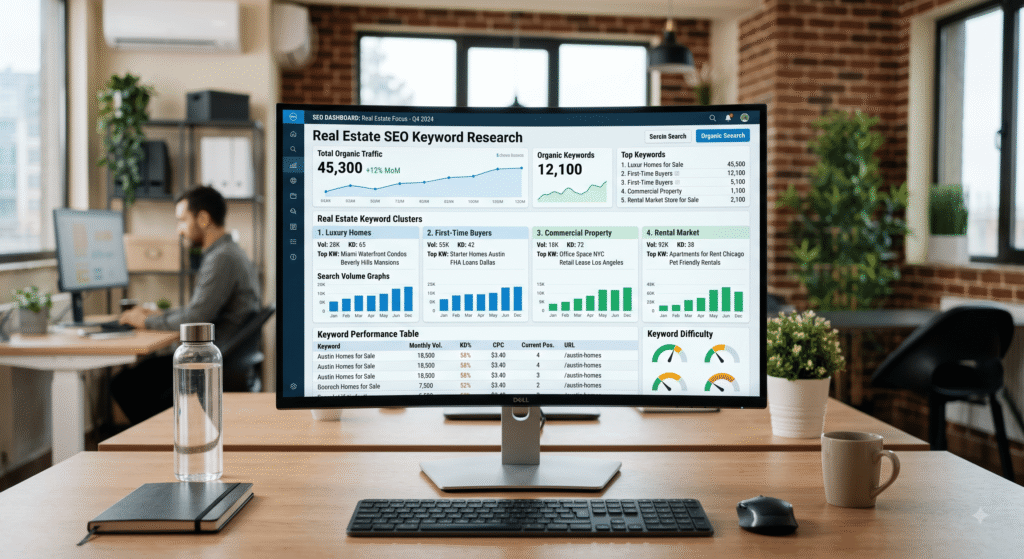
Keyword Research for Real Estate
Keyword research is where most agent SEO either succeeds or wastes a year. The goal is not a giant list. It is a map of what your specific market searches, organized by intent, so every page you build has a clear job.
TREM’s real estate SEO services start every engagement here, because the rest of the plan depends on it.

Best SEO Keywords for Real Estate
There is no universal list of real estate SEO keywords that works for every agent, because the best terms are tied to your market and your inventory.
That said, the highest-value keywords almost always fall into four groups: buyer-intent, seller-intent, neighborhood and geo, and long-tail question terms. The sections below walk through each group with examples you can adapt to your own city, neighborhoods, and price bands.
Buyer-Intent Keywords
These map to inventory and the act of looking. Examples:
- “homes for sale in [neighborhood]”
- “[city] condos for sale”
- “[building name] condos for sale”
- “[neighborhood] real estate”
- “luxury homes for sale in [area]”
These terms carry strong commercial intent and feed your IDX search and neighborhood pages. Volume is often lower than national terms but the people searching are close to a decision.
Seller-Intent Keywords
Sellers signal differently. They research value and timing before they list:
- “how much is my home worth in [area]”
- “[city] home values”
- “is it a good time to sell in [neighborhood]”
- “[area] real estate market report”
- “selling a condo in [building]”
Seller keywords are gold because a single listing is worth far more than a buyer lead, and fewer agents target them well. Pair these with home-valuation tools and market-report content.
Neighborhood and Geo Keywords
This is the core of real estate SEO. People search by place constantly:
- “best neighborhoods in [city]”
- “living in [neighborhood]”
- “[neighborhood] schools”
- “moving to [city]”
- “[neighborhood] vs [neighborhood]”
Each becomes a dedicated geo page or neighborhood guide. Done right, these become the linkable, rankable backbone of your site.
Long-Tail and Question Intent
Long-tail terms have lower volume and far less competition, and they convert well because they are specific:
- “pet-friendly condos in [neighborhood] under 500k”
- “gated communities in [city] with golf”
- “what are closing costs in [state]”
- “do I need a realtor to buy new construction”
These also feed your FAQ schema and increasingly get you cited by AI answer engines, which we cover at the end.
How to Build the Map
Start with seed terms for your market, expand them with a keyword tool to capture volume and difficulty, then sort every term into one of the four intent buckets above.
Group terms that share intent onto a single page rather than building a thin page per keyword. Prioritize by a simple formula: relevance to your business times achievable difficulty given your site’s authority.
A new domain should not open by chasing “Miami real estate.” Start with winnable neighborhoods and long-tail terms, build authority, then climb.
On-Page SEO
On-page SEO is how you tell Google and the reader exactly what a page is about and why it deserves to rank. Get the fundamentals right on every page and you compete. Skip them and even great content stalls.
Title Tags and Meta Descriptions
Your title tag is the single strongest on-page signal you control.
Put the primary keyword near the front, keep it under about 60 characters, and make it specific. “Coral Gables Homes for Sale | [Brand]” beats “Welcome to Our Listings.”
Write a meta description around 155 characters that states the benefit and includes the keyword. The description does not directly affect ranking, but it drives click-through, and click-through affects everything downstream.
Headings and Structure
Use one H1 per page that matches the search intent. Break the body into H2 sections and H3 subsections that mirror how a reader scans.
Headings are not decoration, they are a map for both the reader and the crawler. A neighborhood guide might run H2s for schools, dining, commute, market trends, and current listings.
Content Depth and Quality
Thin pages do not rank in competitive markets. That does not mean padding word count. It means covering the topic completely enough that the searcher has no reason to hit back and try another result.
For a neighborhood page, that is real detail on lifestyle, price ranges, school ratings, walkability, recent sales, and what kind of buyer the area suits. Write from genuine market knowledge. This is where 10 years in real estate shows, because the depth is real, not researched on the fly.
Internal Linking and the Pillar/Cluster Model
Internal links pass authority and tell Google how your pages relate. The model that works in real estate is pillar and cluster. A pillar page covers a broad topic, for example “Living in Miami: The Complete Neighborhood Guide.”
Cluster pages cover the specifics, one per neighborhood, each linking up to the pillar and back down to related clusters. The pillar gathers authority from all the clusters and ranks for the head term, while clusters rank for the specific searches.
Link with descriptive anchor text, not “click here.” A strong internal linking structure is one of the highest-return things you can do, and it costs nothing but planning.
If your current site is not built to support this structure, that is usually a foundation problem. Our real estate websites are built around silos and clean internal linking from the start. Learn more about our real estate website design.
IDX and Listing-Page SEO
This is the section most guides skip and the one that makes or breaks an agent site. IDX brings live MLS listings onto your domain, which is great for users and dangerous for SEO if you handle it wrong.
Get this right and your site stays healthy. Get it wrong and thousands of thin pages can suppress your rankings sitewide.
The Thin and Duplicate Content Problem
Every IDX listing page carries the same MLS-fed description that appears on Zillow, Realtor.com, and every other IDX site in your market.
To Google, that is duplicate content with no unique value. Multiply it by thousands of auto-generated pages and you hand Google a crawl budget problem and a quality problem at once.
The site looks bloated and shallow.
Indexation Strategy
You do not want every listing page in Google’s index. Most listings are transient and duplicate, so let them serve users without competing for crawl attention. A common approach is to noindex individual listing-detail pages while keeping your curated search and neighborhood pages indexable.
Those curated pages, the ones with your unique commentary, are what you actually want ranking. Decide deliberately which page types earn indexation and which serve users only.
Canonical Strategy
Canonical tags tell Google which version of similar content is authoritative. Use them to consolidate near-duplicate search-result variations, for example the same listing set sorted in different ways or reached through different filter URLs.
Point parameter-driven duplicates back to the clean canonical version so you are not splitting signals across dozens of near-identical URLs. This keeps your crawl budget focused on pages that matter.
Where IDXBoost Fits
Generic IDX plugins create exactly the mess described above, then leave you to clean it up. We built IDXBoost, our proprietary in-house IDX platform, specifically to solve real estate’s listing-page SEO problems.
It handles indexation and canonical logic, keeps page speed under control where most IDX tools tank it, and lets curated neighborhood and search pages carry real content instead of bare templates.
Because we built it and we run it, we tune it for SEO rather than working around someone else’s plugin. See how IDXBoost and our real estate marketing fit together.

Local SEO for Real Estate
For most agents, local SEO for real estate drives more qualified leads than anything else, because real estate is inherently local and Google knows it.
When someone searches “real estate agent near me” or “[neighborhood] realtor,” the map pack sits above the organic results. Winning local SEO means winning that map pack and the local-intent organic results around it.
This is also where SEO for real estate agents pays off fastest, since a complete profile and a few geo pages can rank long before a broad content library matures.
Google Business Profile
Your Google Business Profile is the foundation of local. Claim it, verify it, and fill out every field. Use the correct category, write a real description with your market and specialties, add photos regularly, and post updates.
Choose your service areas deliberately. An incomplete or neglected profile loses to a complete, active one almost every time, so treat it as a live asset, not a one-time setup.
NAP Consistency
NAP stands for Name, Address, Phone. These three details must match exactly everywhere they appear online, your site, your Google profile, directories, your brokerage page, social profiles.
Inconsistent NAP, even small differences like “Suite 200” versus “Ste 200,” confuses Google about which business is real and weakens your local ranking. Audit your citations and clean up mismatches.
Local Citations
Citations are mentions of your business on directories and local sites. Real estate directories, your local chamber of commerce, Yelp, and reputable local business listings all count.
They reinforce your legitimacy and your location. Quality and consistency beat raw quantity. A handful of accurate, authoritative citations does more than a hundred sloppy ones.
Neighborhood and Geo Pages
Geo pages are where local SEO and content marketing meet. A dedicated, genuinely useful page for each neighborhood you serve lets you rank for “[neighborhood] homes for sale” and “living in [neighborhood]” while giving real value to buyers.
Make each one distinct. Do not spin up fifty near-identical pages with the city name swapped, because Google treats that as doormat spam and it can hurt you. Each page needs real, specific content about that place.
Reviews
Reviews drive both ranking and conversion. A steady stream of recent, detailed Google reviews lifts your map-pack position and convinces searchers to call you over the next agent.
Ask every closed client for a review, make it easy with a direct link, and respond to every review you get, positive or negative. Recency matters, so a consistent trickle beats a one-time burst.
Content Marketing
Content is the engine that earns rankings, links, and trust at the same time. In real estate, the content that compounds is local, specific, and genuinely useful.
This is where you separate from agents who post generic “5 tips for buyers” filler that ranks nowhere.
Pillar Pages
A pillar page is your authoritative resource on a broad, high-value topic, your complete neighborhood guide to a city, your full buyer’s guide, your relocation guide.
It is long, thorough, and built to be the best answer on the topic.
It anchors a cluster of related posts and gathers their authority. Pillar pages are slow to build and worth it, because they rank for valuable head terms and serve as the hub everything else links to.
Blog Clusters
Around each pillar, build clusters of focused posts that each target a specific long-tail search and link back to the pillar.
If your pillar is a Miami neighborhood guide, clusters cover individual neighborhoods, school comparisons, commute breakdowns, and “[neighborhood] vs [neighborhood]” matchups.
Each post does one job well. Together they cover the topic comprehensively, which is exactly what Google rewards.
Market Reports
Recurring market reports are one of the most underused assets in real estate SEO.
A monthly or quarterly “[city] real estate market report” with real numbers, median prices, inventory, days on market, and your interpretation, ranks for high-intent seller searches, earns links from local press and other sites that cite your data, and positions you as the market authority.
Publish on a schedule and the freshness signals stack in your favor over time. These also feed AI answer engines hungry for current, specific data.
Putting It on a Schedule
Content marketing fails when it is sporadic. A realistic cadence is a few cluster posts per month plus a recurring market report, with pillar pages built and refreshed as anchors. Consistency compounds. For a deeper look at how content ties into the rest of your funnel, see lead generation for realtors.
Technical SEO
Technical SEO is the foundation everything else sits on. You can write the best neighborhood guide in your market, but if Google cannot crawl it, your site is slow, or it breaks on mobile, none of it ranks. The good news is most technical SEO is a set of fixable problems, not an endless project.
Site Speed and Core Web Vitals
Speed is a ranking factor and a conversion factor. Real estate sites are especially prone to slowness because of heavy IDX scripts and large property images.
Core Web Vitals are Google’s specific speed and stability metrics: Largest Contentful Paint should come in under 2.5 seconds, Interaction to Next Paint should stay low, and Cumulative Layout Shift should stay near zero so the page does not jump as it loads. Compress images, lazy-load below-the-fold content, cut unnecessary scripts, and use a fast host. IDX is the usual culprit, which is one more reason the platform you run matters.
Mobile-First
Google indexes the mobile version of your site, and most real estate searches happen on phones.
Buyers browse listings from the couch and from the car.
Your mobile experience is not a secondary concern, it is the primary one. Test every key page on a real phone. Tap targets, load speed, and readable text without zooming all matter.
Real Estate Schema Markup
Schema is structured data that tells search engines exactly what your content is, and it helps both traditional rich results and AI answer engines understand you.
Real estate schema markup is one of the easiest technical wins available, because most agent sites ship with none of it. For real estate, the schema that matters most:
- RealEstateAgent or LocalBusiness schema on your contact and about pages, with your NAP, hours, and service area
- FAQ schema on pages with question-and-answer content, which can earn expanded results and feed answer engines
- Article schema on blog posts and market reports
- BreadcrumbList schema to reinforce your site structure
Implement your real estate schema markup cleanly and validate it. Schema does not guarantee rich results, but without it you leave easy signals on the table.
Crawlability and Sitemaps
Google has to be able to find and crawl your pages. Keep a clean XML sitemap that lists the pages you want indexed and submit it in Search Console.
Use your robots.txt to guide crawlers away from low-value parameter URLs and toward what matters. Watch your crawl budget, especially on large IDX sites, so Google spends its attention on your money pages instead of thousands of thin listing variants.
Fix broken links and redirect chains, because they waste crawl budget and frustrate users.
Link Building for Real Estate
Backlinks remain one of the strongest ranking signals, and real estate gives you natural, honest ways to earn them that many niches lack.
The key word is honest. Buying links or chasing spammy directories gets you penalized. The tactics below build authority that lasts.
Digital PR and Local Press
You have data and expertise local journalists need. Your market reports, predictions, and commentary on local real estate trends are exactly what reporters quote.
Pitch your data to local outlets, offer expert commentary, and become the agent the press calls. A single link from a local news site carries real weight and sends qualified traffic.
Local Sponsorships and Community Involvement
Sponsor a local event, youth sports team, charity run, or community organization, and you often earn a link from their site plus genuine local goodwill.
These links are relevant, local, and hard for competitors to replicate because they reflect real involvement in your community. They reinforce exactly the local signals Google wants to see from a real estate business.
Partnerships and Referral Relationships
Mortgage brokers, home inspectors, contractors, interior designers, relocation services, and local businesses all make natural link partners.
A resource page that lists your trusted local vendors, and reciprocal mentions where they list you, builds a web of relevant local links. Keep it genuine and useful rather than a link-swap scheme.
Linkable Assets
The most reliable way to earn links at scale is to build things worth linking to.
A genuinely useful neighborhood guide, an interactive market-data tool, a relocation resource, or an annual market report gives other sites a reason to link to you without being asked.
Linkable assets do double duty, ranking on their own and pulling in links that lift your whole domain. This is slower than buying links and far more durable, which is the entire point.

Measuring SEO
If you cannot measure it, you cannot improve it, and you cannot prove it is working.
The metrics below tell you whether your SEO is producing, and which levers to pull next. We report on these monthly for every client, because measurable ROI is the whole point.
Rankings
Track your target keywords over time. Rankings are a leading indicator, they move before traffic and leads do, so they tell you early whether your work is landing.
Track by location, since real estate rankings vary by where the searcher is. Do not obsess over a single keyword. Watch the overall trend across your keyword map.
Organic Traffic
Organic sessions show whether rankings are translating into visits. In GA4, segment organic search traffic and watch the trend month over month and year over year.
Look at which pages pull traffic, because that tells you what is working and where to double down. Rising organic traffic on your neighborhood and market-report pages is exactly the pattern you want.
Leads and Conversions
Traffic that does not convert is vanity. Set up conversion tracking in GA4 for the actions that matter: contact-form submissions, home-valuation requests, listing-alert signups, and calls.
Tie leads back to the pages and keywords that produced them so you know which content earns business, not just clicks. This is the number that justifies the investment.
GA4 and Search Console
These two free tools cover most of what you need. GA4 tracks traffic and conversions. Google Search Console shows you the actual queries you rank for, your average position, click-through rates, and any indexation or crawl problems.
Check Search Console regularly for coverage errors, especially on IDX-heavy sites where indexation issues hide. Together they give you a full picture of search performance for free.
Common Mistakes
These are the errors we see sink agent sites again and again. Avoid them and you are ahead of most of your competition before you publish a word.
Letting IDX Run Wild
Indexing thousands of thin, duplicate listing pages is the single most common and most damaging mistake. It bloats your site, wastes crawl budget, and drags down quality signals across your domain. Manage indexation and canonicals from day one.
Thin Doorway Geo Pages
Spinning up dozens of near-identical neighborhood pages with only the place name swapped is doorway spam, and Google penalizes it. Every geo page needs real, specific content about that place or it does more harm than good.
Chasing Head Terms Too Early
A new or low-authority site that opens by targeting “[major city] real estate” wastes a year losing to established competitors. Start with winnable neighborhood and long-tail terms, build authority, then climb to the head terms.
Ignoring the Seller Side
Sites that chase only buyer keywords leave listings on the table. Seller searches convert to higher-value business and face less competition. Build for both audiences.
Treating SEO as One-and-Done
SEO is a channel, not a project. Agents who publish a few pages and walk away see nothing. Agents who build month over month see compounding returns. Consistency is the differentiator.
Neglecting the Google Business Profile
An unclaimed or stale profile loses the map pack to active competitors. It is free, it pays off quickly, and too many agents ignore it.
A Realistic Timeline of Results
Anyone promising page-one rankings in 30 days is lying or about to get you penalized.
Real estate SEO is an investment that compounds, and honest expectations keep you from quitting right before it pays off. Here is what a realistic arc looks like.
Months 1 to 3:
Foundation. Technical fixes, keyword mapping, site structure, Google Business Profile, and the first content.
You will see early movement on low-competition long-tail terms and local signals starting to register. Few leads yet. This is groundwork.
Months 4 to 6:
Traction. Content published in the first months starts ranking.
Neighborhood and long-tail pages climb. Organic traffic shows a clear upward trend, and the first organic leads come in. Momentum builds.
Months 7 to 12:
Acceleration. Your pillar and cluster structure matures, authority grows, and you start ranking for more competitive terms.
Organic traffic and leads grow meaningfully. The cost per lead drops as content keeps producing on a fixed cost.
Year 2 and beyond:
Compounding. This is where SEO pulls away from paid channels. Your library of ranking content produces leads at a steadily falling cost. You compete for head terms.
The asset you built keeps working while you add to it. Agents who stayed the course now have a pipeline competitors cannot easily buy their way past.
Timelines shift with your market’s competitiveness, your domain’s starting authority, and how aggressively you publish. A luxury Miami market moves slower than a smaller suburb. The direction holds regardless: slow start, compounding returns.
AI Search and Answer Engines
Search is changing. AI answer engines and AI overviews increasingly answer questions directly, citing sources instead of sending every searcher to ten blue links. For real estate, this is an opportunity, because being the cited source on local market questions builds authority at the exact moment a buyer or seller is deciding who to trust.
The work that wins here overlaps heavily with good SEO.
Clear, specific, well-structured content answers questions directly. FAQ and structured data help machines parse you. Current, accurate market data, the kind in your recurring market reports, is exactly what answer engines pull from because it is specific and fresh.
Genuine expertise and authority signals, the same E-E-A-T factors Google already rewards, make you a source worth citing.
You do not need a separate AI strategy. You need content that answers real questions with real specifics, marked up cleanly, published consistently, backed by genuine market knowledge. Do that and you show up in traditional search and answer engines at once. Chasing AI with thin, generic content fails in both.
Let’s Build Your Organic Pipeline
Real estate SEO rewards the agents and brokerages who commit to it. The work is concrete, the timeline is honest, and the payoff is a pipeline you own instead of rent.
You stop bidding against every other agent in town for the same shared lead and start earning buyers and sellers who searched and found you.
We have spent more than 10 years working exclusively in real estate, built our own IDXBoost platform to solve the listing-page problems that sink most agent sites, and we keep design, SEO, and content under one roof so the whole system pulls in the same direction.
Our real estate SEO services cover everything above, from keyword mapping and IDX cleanup to local SEO and content. From Miami luxury to new-development marketing, we know what ranks in this niche because it is all we do. Browse more on our blog.
If you are ready to stop renting leads and start building an asset, let’s talk.
Book a free consultation and we will review your site, your market, and your biggest opportunities, no obligation. Reach us at info@tremgroup.com.
Ready to Boost Your Sales?
We Know exactly what it takes to drive real results. Let’s craft a strategy that helps you close more deals and accelerate your growth. It’s time to make things happen.The post Real Estate SEO: The Complete Guide to Ranking #1 appeared first on TREMGroup.
from TREMGroup https://ift.tt/g4eanU2
Marketing Exposes Broken Businesses #shorts
The phrase "bad leads" is usually a symptom of a broken sales process.
Online search behavior is inherently exploratory in the early stages.
Expecting immediate transactions from top-funnel traffic is an unrealistic approach to digital growth.
High-performing teams understand that a digital contact is simply the start of a relationship.
If you do not have the patience to nurture early-stage buyers, you lose them to companies who do.
True lead conversion requires a balance of timing, consistency, and patience.
Our real estate systems are designed to help you monitor this journey without losing active prospects.
Fixing your long-term follow-up is the only way to scale your real estate marketing successfully.
How long does your team typically nurture an online contact before they convert? Let us know in the comments.
via
via
Friday, August 28, 2026
Trem Group: Revolutionizing Real Estate Marketing #shorts
A lot of people think digital success is just about looking good, but a nice design doesn't pay the bills if it doesn't bring in sales.
At TREMGroup, we handle the tech for the brands leading the luxury real estate sector. We help top producers scale using custom real estate websites that focus on real data over decoration.
We stop your team from wasting time on cold calls. We design systems that make serious buyers and sellers find you instead.
A good real estate strategy needs a strong foundation. We connect your tools so your business runs smoothly and always has fresh prospects ready for your real estate clients.
How much time does your team spend chasing cold leads every week instead of booking automatic appointments? Let’s talk in the comments.
via
via
Thursday, August 27, 2026
How international buyers find your Miami real estate website [60]
Cross border relocation is one of the most profitable sectors in luxury real estate today.
High net worth investors from Canada use search engines to discover local market experts in Miami.
A modern digital presence expands your reach far beyond your physical neighborhood boundaries.
Capturing a two million dollar buyer requires strong visibility and a solid digital infrastructure.
Your real estate marketing campaigns must establish global authority to attract these premium clients.
Smart backend real estate systems ensure your brand ranks high when global buyers start their search.
Expanding your digital window of opportunity directly impacts your long term lead conversion rates.
At TREMGroup, we design the global platforms that bring international wealth straight to your pipeline.
Is your website optimized to capture buyers moving from other countries? https://ift.tt/Vrdvzw3
via
via
Wednesday, August 26, 2026
Is your real estate website making money or just looking pretty?
Real estate website conversion and functional utility are the only metrics that keep your business growing.
A clean design is nice, but an expensive layout is completely useless if visitors leave without sharing their contact details.
A successful real estate website must focus entirely on starting new customer relationships.
True real estate marketing is about building a system that works for you every single day.
We create modern real estate systems designed to turn basic internet traffic into real business growth.
Stop spending money on digital tools that only exist to look pretty on your laptop screen.
Click the save button on this post to keep this rule in mind for your next update.
Increase your sales: https://ift.tt/zWw1jC6
Lead Generation for Real Estate: https://ift.tt/fdmJD49
New Construction Marketing: https://ift.tt/6TQkpPN
Websites for Real Estate Agents, Teams & Brokers: https://ift.tt/L453wZp
Case Studies: https://ift.tt/MFzThZ6
Client Testimonials: https://ift.tt/7z5y8Va
Info email: info@tremgroup.com
Website: www.tremgroup.com
Our socials:
Facebook: https://ift.tt/TKCuv5a
Instagram: https://ift.tt/WqfedEy
LinkedIn: https://ift.tt/gPe86f0
X: https://twitter.com/tremgroup
Linktree: https://linktr.ee/tremgroup
via
via
Facebook Ads vs Google Ads: what is a good real estate cost per lead? [84]
A successful digital strategy requires understanding the true value behind your marketing budget.
Social media platforms deliver a high volume of casual contacts at a lower price point.
Search engine campaigns target high intent buyers who are actively looking to invest right now.
Shifting your focus from cheap clicks to long term return on investment changes your entire business.
Top brokerages use advanced real estate systems to track where their best clients come from.
Analyzing this data allows you to optimize your real estate marketing spend for actual profit.
At TREMGroup, we design the custom infrastructure that improves your overall lead conversion.
What is your average cost per lead on your current active campaigns? Let us know in the comments.
via
via
Tuesday, August 25, 2026
I watched this neighborhood’s prices jump to $4,200 a square foot
Tracking hyper local data over a decade reveals exactly how luxury markets mature.
The introduction of ultra luxury hospitality brands completely resets the local baseline for real estate values.
We are witnessing an unprecedented shift in pricing as newer developments cross historical valuation metrics.
Understanding these historical market cycles is the only way to accurately guide international buyers today.
We discuss this massive neighborhood transformation in the final part of our series on the pipeline podcast.
Do you think these premium price increases are sustainable long term? Let us know.
via
via
Subscribe to:
Posts (Atom)